- Osiris News
- Posts
- 📉⚔️ Wall Street’s War on Bitcoin
📉⚔️ Wall Street’s War on Bitcoin
Wall Street's Bitcoin battle unfolds as ETF outflows signal extreme market fear, revealing a brutal 36% price descent and complex financial dynamics.

Dr. P
November 24, 2025

In partnership with

📉⚔️ Wall Street’s War on Bitcoin
Hello there you embodiment of curiosity;
Welcome to today's edition of Osiris News, where the mood is thick and quiet. The market feels like a boxer in the late rounds, leaning on the ropes, taking body blows. Bitcoin is trading near $87,900, but the number is a lie. It does not capture the exhaustion. It does not show the fourth straight week of money walking out the door, $1.22 billion pulled from the Bitcoin ETFs, a quiet and orderly retreat. The sentiment gauges are flashing a color I call "Extreme Fear," which is a polite way of saying people are checking their portfolios with the same enthusiasm they might use to open a final notice from the tax office.
The charts tell a simple, brutal story. Bitcoin fell from a peak of $126,000 to touch $81,000. That is a 36 percent drop. It is the kind of number that makes your stomach feel hollow. A technical indicator called a "death cross" has appeared, which happens when a short-term price average falls below a long-term one. It sounds like something out of a pirate movie, and while it’s often less dire than the name suggests, it does little to soothe the nerves of a trader in Singapore watching their screen at three in the morning. The fight right now is not for new highs. It is a fight to hold the line.
🔍 Quick Overview
Market Bleeds Red: Bitcoin is struggling to hold $86k after a 36% drawdown, as spot ETFs see a fourth straight week of heavy outflows. Investor sentiment has officially entered the "Extreme Fear" zone.
Wall Street Builds a Wall: JPMorgan is facing a boycott after an MSCI proposal could force firms like MicroStrategy out of major indexes. The move feels less like a rebalance and more like a targeted strike against corporate Bitcoin treasuries.
Cardano's Accidental Split: Cardano briefly forked into two separate blockchains after a staking pool operator exploited an old bug. The crisis was contained, but with the FBI now involved, the incident has sent a chill through the developer community.
Monad's Rocky Launch: The high-speed Monad blockchain is live, but its tokenomics are already drawing fire. A tiny 3.3% airdrop next to a hefty 27% team allocation has the community asking pointed questions.
AI's Physical Problem: The AI and DePIN sectors provided a rare flash of green, both up 9% on renewed speculative interest. The boom is running headfirst into the physical world, however, bottlenecked by a supply of rare earth minerals controlled by China.
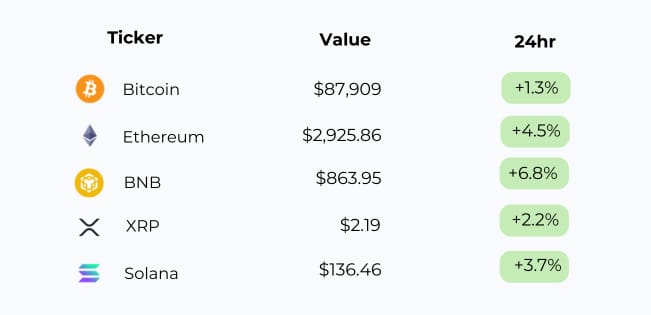
Today’s bounce shows traders buying the dip: ETH and BNB led the recovery, SOL snapped back fast as usual, and BTC stabilized after the recent slide. It’s a cleaner rebound, but still looks like short-term relief rather than a trend change.

New From Us
|

Five minutes, one brief, you are up to speed on AI
Trending News
Global crypto investment products saw nearly $1.9 billion in outflows last week, marking the fourth consecutive week of withdrawals totaling $4.9 billion. U.S. spot Bitcoin ETFs accounted for $1.2 billion of the weekly outflows, reflecting widespread investor de-risking and "Extreme Fear" sentiment.
MSCI is reviewing MicroStrategy's inclusion on key indices due to its massive Bitcoin holdings, with a decision expected by early 2026. Analysts estimate an exclusion could trigger an automatic sell-off of $2.8 billion from index-tracking funds, putting considerable pressure on MSTR's valuation.
The new Monad Layer 1 blockchain officially launched its mainnet after raising approximately $269 million from 85,820 participants on Coinbase's new ICO platform. Monad aims to solve the blockchain trilemma using "optimistic parallel execution" to achieve high speed and sub-second finality.
Cardano experienced a temporary network partition when a single, malformed transaction caused a split between updated and older nodes, halting ADA deposits on major exchanges for hours. Founder Charles Hoskinson publicly accused the developer of a "premeditated attack," leading to the immediate resignation of an IOG developer.
This tiny pause brought to you by “please let this help pay the bills” 👀
Partnered Spotlight
The Smartest Free Crypto Event You’ll Join This Year

Curious about crypto but still feeling stuck scrolling endless threads? People who get in early aren’t just lucky—they understand the why, when, and how of crypto.
Join our free 3‑day virtual summit and meet the crypto experts who can help you build out your portfolio. You’ll walk away with smart, actionable insights from analysts, developers, and seasoned crypto investors who’ve created fortunes using smart strategies and deep research.
No hype. No FOMO. Just the clear steps you need to move from intrigued to informed about crypto.
Beyond the Noise
This is not a simple market correction. This is a squeeze. The pressure is coming from two directions. On one side, you have the raw mechanics of fear. On the other, you have the deliberate, methodical pressure of the old financial world.
The news from JPMorgan landed like a stone in a quiet pond. The bank relayed a proposal from MSCI, one of the world's most important index providers. The plan is to kick companies that hold Bitcoin as a primary treasury asset out of their major stock indexes. This is aimed squarely at firms like MicroStrategy. An index is just a list of stocks, a recipe for big investment funds. If you get kicked off the list, giant funds that follow that recipe are forced to sell your stock. They have no choice.
The Bitcoin world saw this not as a technical adjustment, but as a declaration of war. Calls to boycott JPMorgan erupted. Michael Saylor, the head of MicroStrategy, argued his company is a software business that uses Bitcoin productively, not just a passive box for holding coins. But the message was clear. The old guard is setting new rules for the clubhouse, and they are not fond of members who bring their own, strange new money. This was made sharper when JPMorgan also abruptly closed the bank accounts of Jack Mallers, the CEO of Strike, citing only vague concerns. It feels less like risk management and more like a coordinated de-platforming.
While the bankers in New York were sharpening their knives, a different kind of failure was unfolding on the Cardano network. It was stranger, messier, and somehow more human. Over the weekend, the blockchain simply split in two.
Imagine a single railroad track suddenly becoming two parallel tracks, with trains running on both, unaware of each other. That is what happened. A staking pool operator, messing around with what he later claimed were faulty instructions from an AI, found a bug in some old code. He created a transaction that newer versions of the Cardano software accepted, but older versions rejected. This disagreement was enough to fracture the consensus. For hours, there were two Cardanos.
The problem was fixed. The rogue chain was abandoned, and the network stitched itself back together. But the price of its token, ADA, fell hard. The founder, Charles Hoskinson, was furious, calling the act personal and announcing the FBI was now involved. A developer, spooked by the idea that a mistake could now bring federal agents to your door, publicly resigned. The incident was a perfect little parable for the state of things. Our multi-billion dollar financial machines are still fragile enough to be broken by one curious person with a bit of bad code, and the consequences are no longer just financial. They are real, and they involve men with badges.
Amid the wreckage and the institutional attacks, some people are still trying to build new things. The Monad blockchain launched its mainnet. It is another contender in the race to build a faster, more efficient network. Its main selling point is something called "parallel execution." Think of a bank with only one teller. Every customer has to wait in a single line. Parallel execution is like opening a dozen new teller windows at once. It processes many transactions simultaneously, making everything much faster.
The launch was a technical success. But it arrived with a human problem. The project’s token distribution was revealed, and the community soured. While 3.3% of the tokens were airdropped to early users, 27% were allocated to the team and insiders. It felt, to many, like being invited to a grand opening only to find the best seats were already taken. Even our newest creations are born with the old sins of inequity.
Zooming out from all this, you find a deeper, stranger story. The speculative energy that has left Bitcoin and Ethereum has not vanished. It has flowed into newer sectors, like AI and DePIN. DePIN stands for Decentralized Physical Infrastructure. It is a fancy term for using crypto tokens to pay people to build real-world things, like wireless networks or sensor grids. Both of these sectors are booming.
But this digital boom is running headlong into a physical wall. The AI revolution, with its massive data centers and powerful chips, is incredibly hungry for a specific set of materials: rare earth minerals. And China controls nearly all of the global supply. This has turned a tech story into a geopolitical one. The United States government is now pouring hundreds of millions of dollars into funding domestic mines and magnet factories, trying to build a secure supply chain. It is a stark reminder that our weightless, digital world is anchored to the dirty, physical one. The price of an AI token in your wallet is now connected to the output of a mine in Wyoming and the strategic calculations of policymakers in Washington and Beijing.
This Caught My Eye:

Source : Bitbo
Here’s a breakdown of the chart:
Long-dormant Bitcoin supply is at its highest levels ever, with more than 30% of all BTC unmoved for 5+ years, meaning a huge chunk of supply is effectively frozen — whether lost or held with extreme conviction.
This deepening “HODL wave” concentration makes Bitcoin structurally supply-tight, but it also highlights the quantum-risk dilemma: if old addresses become vulnerable, a massive amount of long-idle coins could suddenly re-enter the market.
Looking Ahead
The market is caught in a difficult position. It is fighting a battle on three fronts. It is fighting a crisis of confidence, as ETF outflows and scary chart patterns drive away capital. It is fighting an external war against institutional powers that want to contain it or control it. And it is fighting an internal war against its own complexity and fragility, where a single bug can split a network in two.
The question for the coming weeks is which of these pressures will break something important first. Will the price find a floor before the fear becomes a full-blown panic? Can the industry build defenses faster than the old guard can build walls? And can the code that underpins this entire experiment hold together under the strain?
We will be watching the US inflation data due out soon. In a market this fragile, any macro-economic news, good or bad, could be the gust of wind that decides which way the structure leans. For now, the boxer stays on the ropes, waiting for the bell.
Until tomorrow,
- Dr.P
Be honest — was today’s Osiris worth the scroll? |
If this newsletter saved you time today or made you smirk even once, your support goes a long way. I write it solo, daily and your support really helps!