- Osiris News
- Posts
- 🏦🛑 Deposits: BofA Warns Stablecoins Drain $6T
🏦🛑 Deposits: BofA Warns Stablecoins Drain $6T
Bank of America signals massive $6T deposit disruption as Bitcoin hovers in volatile range, revealing critical macro shifts in finance's emerging technological frontier.

Dr. P
January 16, 2026
Welcome to today's edition of Osiris News. Bitcoin remains stuck in a tight corridor between $90,000 and $96,000. The market mechanism here is a gamma trap, where options dealers are mechanically hedging against volatility, effectively neutralizing over $1.8 billion in spot ETF inflows this week alone. While price action chops sideways, the real conflict has moved to Washington. The Senate Banking Committee delayed the markup of the crypto market structure bill after Coinbase withdrew support.
This isn't just legislative gridlock; it is an open turf war over the future of banking deposits. Bank of America explicitly warned that interest-bearing stablecoins could drain $6 trillion from the commercial banking system. That number explains the ferocity of the lobbying effort better than any ideological argument. The industry is currently caught between massive institutional adoption on the front end and a desperate defensive war by incumbents on the back end.
🔍 Quick Overview
Bitcoin ETFs: $1.8B in weekly inflows met a gamma trap. Price remains pinned, ignoring demand.
US Regulation: Banks flag a $6T stablecoin risk, stalling legislation. A predictable turf war.
TradFi Adoption: The DTCC is piloting a blockchain repo market. The real infrastructure build is quiet.
Platform Risk: X API changes crush "InfoFi" tokens. Building on rented land has consequences.
Privacy: Korea bans exchanges from app stores while Zcash gets a pass. Access is the chokepoint.
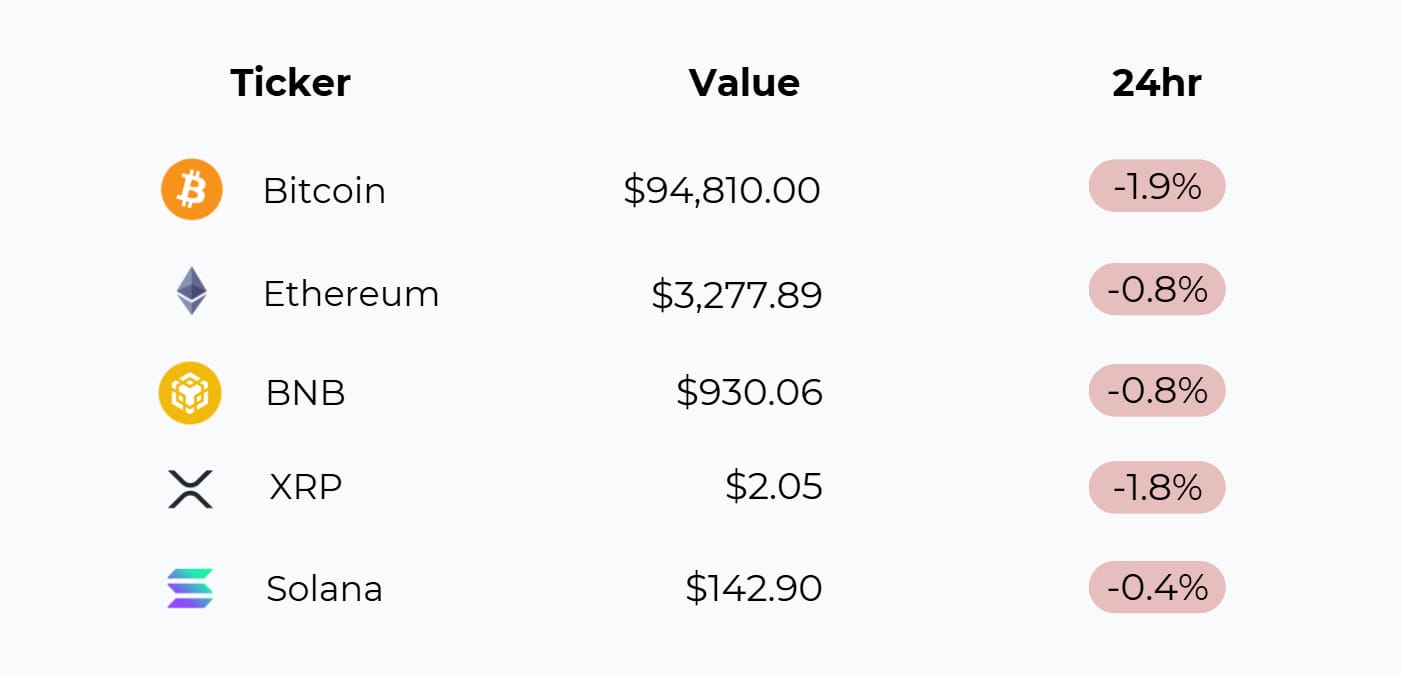
Bitcoin is currently setting the pace with a nearly two percent decline, marking it as the clear laggard among major assets as the broader market pulls back. While XRP is tracking closely behind BTC’s downside move, assets like Ethereum, BNB, and Solana are demonstrating relative resilience, registering losses of less than one percent on the 24-hour tape.
Trending News
Options dealers' mechanical hedging has pinned BTC between $90k and $96k, absorbing $1.8B in weekly ETF inflows. This "gamma trap" suppresses volatility, forcing dealers to sell rallies until contracts expire or volume spikes.
The SEC granted the DTCC a "no-action letter" to pilot tokenizing assets, targeting the $12.6T repo market first. This regulatory greenlight moves blockchain from theory to active infrastructure for settling trillions in US securities.
Google will remove unlicensed exchanges like Binance and OKX from the Korean Play Store on Jan 28. This policy enforces local FIU compliance, severing mobile access for millions of users to major offshore liquidity.

New From Us
|

Five minutes, one brief, you are up to speed on AI
Beyond the Noise
The disconnect between flows and price is the defining feature of this week. Spot Bitcoin ETFs absorbed $840 million on January 14 alone, yet the price refuses to break $96,000. Dealers are short gamma, forcing them to sell into rallies and buy into dips to stay risk-neutral. This mechanical suppression masks the underlying demand. Consensus data shows a unified optimistic outlook for both market leaders, suggesting that once the options expiry clears the dealer inventory, the suppression trade likely breaks. The analyst pulse is steady, ignoring the chop and focusing on the accumulation.
The legislative delay in the Senate is a direct result of traditional finance waking up to the threat of stablecoins. When the CEO of Bank of America flags a $6 trillion risk to deposits, legislation stops moving. The banking lobby is attempting to ringfence yield generation, ensuring that only banks can pay interest on deposits. Coinbase’s refusal to support a bill that bans crypto yield products is a calculated standoff. They are betting that no bill is better than a bill that permanently cements a banking monopoly on yield.
While the banks fight the legislation, the infrastructure is being built regardless. The SEC issued a no-action letter to the DTCC to pilot a blockchain settlement program for the $12.6 trillion repo market. Simultaneously, Galaxy Digital closed a $75 million CLO on Avalanche, and Interactive Brokers enabled 24/7 account funding via USDC. This is the quiet, foundational shift. The plumbing is moving on-chain even as the front-end interface remains politically contentious.
The platform risk of building on centralized social networks materialized instantly for the "InfoFi" sector. X revoked API access for apps that incentivize engagement, causing tokens like KAITO to crash over 14%. Relying on Twitter’s data firehose was always a single point of failure. The pivot to "studio" models is a forced reaction, not a strategic upgrade. It highlights the fragility of protocols that lack their own sovereign data layer.
On the privacy front, the regulatory grip is tightening and loosening simultaneously. South Korea is effectively banning unlicensed global exchanges from mobile app stores, cutting off retail access to Binance and OKX. Conversely, the SEC reportedly closed its investigation into the Zcash Foundation without action, and Cake Wallet is now defaulting to shielded transactions. The signal is mixed but clear: privacy infrastructure is hardening at the protocol level while access points are being choked at the app store level.
This Caught My Eye:

Here’s a breakdown:
BTC’s muted upside skew into the yearly open, followed by a sharp shift to downside skew, supports the idea that early-January strength was driven more by tax-loss sellers twapping back in than by fresh risk appetite.
For alts, the strongest weekly gains since Aug 2025 look more like a reflex “relief bounce” off depressed year-end levels than confirmed new demand, unless we see follow-through in volumes, breadth, and funding over the next few weeks.
Looking Ahead
The immediate focus is the $96,000 resistance level and the options expiry that could release the gamma pin. If price breaks $98,000, dealers will be forced to chase the rally, likely triggering a volatility expansion. Watch for the rescheduled Senate markup dates; the delay gives the banking lobby time to entrench, but it also allows the industry to regroup. The Federal Reserve's policy meeting later this month and planned liquidity injections will likely act as the next macro catalyst. Until then, expect the mechanical hedging to dampen any impulse moves. Sentiment across major assets remains firmly positive with broad alignment.
Until tomorrow,
- Dr.P
Be honest — was today’s Osiris worth the scroll? |
If this newsletter saved you time today or made you smirk even once, your support goes a long way. I write it solo, daily and your support really helps!